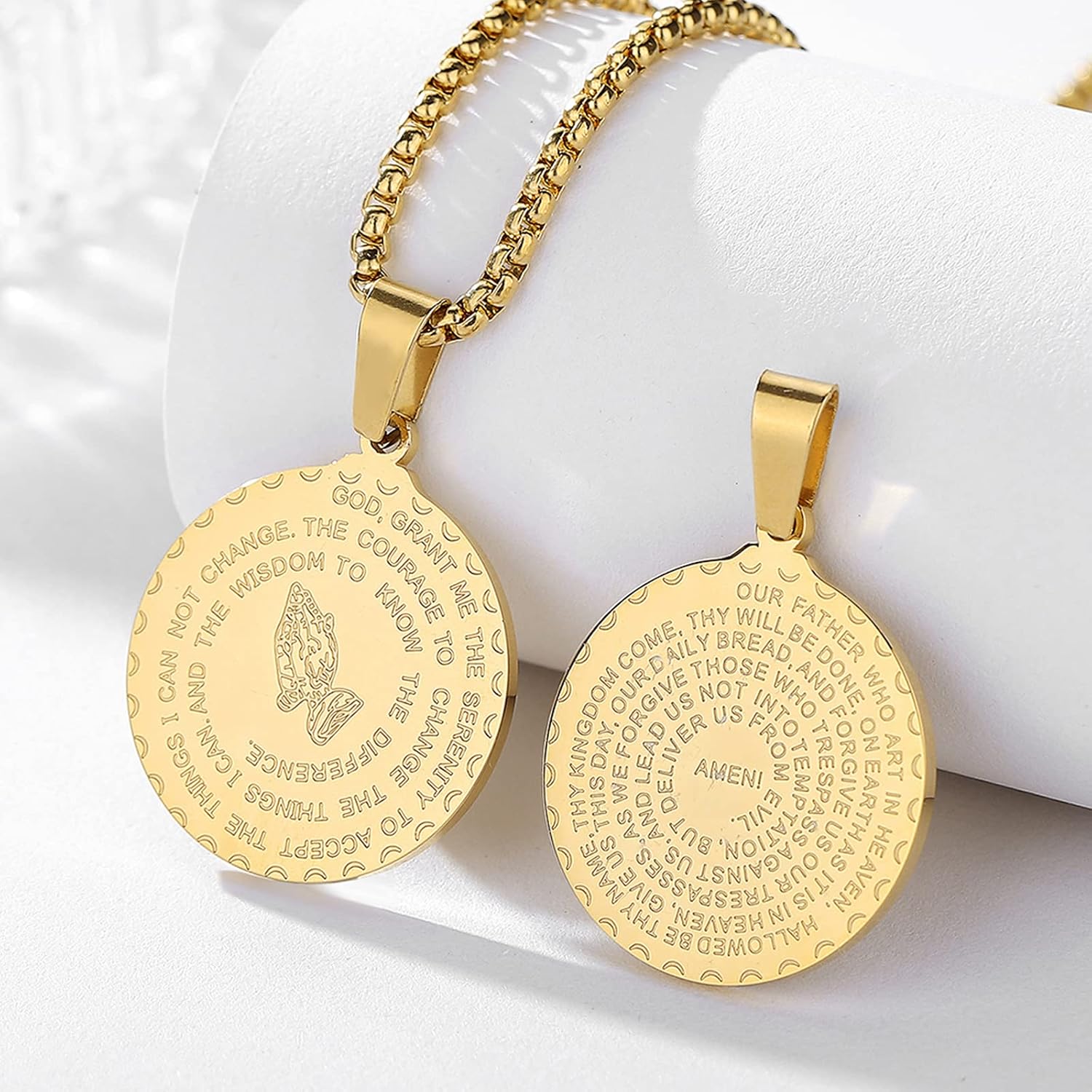
A scripture necklace is exactly what it sounds like: a piece of jewelry — usually a pendant on a chain — that carries a Bible verse, a single word of faith, or a religious symbol. It might be a thin gold disc stamped with “Jeremiah 29:11,” a sterling-silver bar engraved with “She is clothed in strength,” or a solid-gold cross set with diamonds. What makes this category different from ordinary jewelry is intention: the person wearing it or receiving it as a gift is meant to carry a piece of meaning close to their heart, literally. That’s why choosing the right one matters. A birthday present and a baptism keepsake are not the same kind of moment, and a $22 gold-plated charm and a $195 solid-gold pendant are not the same kind of object. This guide walks you through the full range — materials, price tiers, style, and occasion — so you can match the gift to the moment with confidence.
What the Labels Actually Mean: A Quick Materials Primer
Before you can compare options, you need to speak the language. Jewelry listings are full of terms that sound similar but describe very different things. Here’s what to look for on a product page.
Gold-filled means a layer of real gold has been mechanically bonded to a base metal (usually brass). The gold layer is thicker than plating — typically 5% of the item’s total weight by law in the U.S. Gold-filled pieces resist tarnishing significantly better than plated ones and can last years with normal care. You’ll see this on many mid-range faith jewelry pieces in the $40–$90 window.
Gold-plated means a very thin layer of gold (measured in microns) is deposited over a base metal. It’s less expensive to produce, which is why you find it at the $15–$35 price point. It can look identical to gold-filled at first glance, but it wears away faster, especially at friction points like the bail (the small loop where the pendant meets the chain). Fine for a casual, trend-driven piece; not ideal for a milestone gift meant to last decades.
Vermeil (pronounced “ver-MAY”) is a specific standard: sterling silver coated with at least 2.5 microns of gold. Per Good Housekeeping’s jewelry explainer, vermeil sits meaningfully above standard gold-plating in durability and is the correct term when a jeweler says “gold over silver.” It’s common in the $60–$130 range and is a solid middle-ground choice.
Solid gold (10k, 14k, or 18k) contains no base metal core. The “k” designation (karat) tells you the gold-to-alloy ratio: 14k is 58.3% pure gold, 18k is 75%. Solid gold will not tarnish, does not flake, and — critically for a gift you want to last generations — can be resized, repaired, and passed down. Prices for solid-gold scripture pendants typically start around $150 and can run well past $400 depending on weight and design complexity.
Sterling silver is 92.5% pure silver (look for the “925” hallmark). It’s a legitimate precious metal with real longevity when cared for. Many of the most beautiful scripture pendants — especially those from independent Christian artisans — are offered in sterling as their primary or only metal option. Sterling can tarnish with exposure to air and moisture, but a polishing cloth restores it quickly.
By the Numbers: Scripture Necklace Price Tiers at a Glance
| Price Range | Typical Material | Best For |
|---|---|---|
| $15 – $40 | Gold-plated, brass | Stocking stuffer, group gift, casual daily wear |
| $40 – $90 | Gold-filled, sterling silver | Confirmation gift, teacher appreciation, everyday faith jewelry |
| $90 – $175 | Vermeil, sterling + gemstone | Graduation, baptism, milestone birthday |
| $175 – $400+ | Solid 14k or 18k gold | Wedding, heirloom, ministry leader recognition |
Matching the Occasion to the Tier
This is where most buyers go wrong — not because they choose the wrong verse, but because they choose the wrong price tier for the emotional weight of the moment. Relevant Magazine’s 2024 trend report on faith jewelry noted that the fastest-growing segment of faith-forward jewelry purchases is the milestone-occasion category, where buyers are increasingly willing to invest in something lasting rather than something cheap and symbolic.
Here’s a practical frame:
Casual or group gifting ($15–$40): A gold-plated “John 3:16” disc pendant from a mass-market retailer is entirely appropriate when you’re buying a thank-you gift for a Sunday school volunteer or a small token for a women’s Bible study group. At this tier, presentation matters more than longevity — tuck it into a meaningful card and don’t overthink the metal.
Meaningful personal gifts ($40–$90): Gold-filled and sterling pieces at this range are where the gift starts to feel considered. Brands like DaySpring and accessible direct-to-consumer jewelers produce well-designed scripture pendants in this tier. A confirmation gift for a 14-year-old, a pastoral appreciation necklace, or a baptism gift for an adult convert fits here comfortably. Owners of gold-filled pieces consistently report they wear them daily for 3–5 years without noticeable wear — a meaningful upgrade over plated options for not much more money.
Milestone investing ($90–$175): Vermeil and sterling-with-gemstone pieces occupy this range, and this is where personalization — hand-engraving, birthstone accents, custom verse selection — becomes standard. A graduation gift, a 25th wedding anniversary present for a faith-centered couple, or a “first Bible verse she memorized” pendant for a daughter heading to college all land here. Caitlyn Minimalist, one of the more visible names in this space, offers scripture pendants and faith-adjacent personalized jewelry in this tier; across aggregated reviews, buyers consistently note the clean engraving quality and the packaging experience.
Heirloom territory ($175 and up): Solid gold is a different conversation. You’re not buying a piece of jewelry — you’re commissioning an object that will exist in a family for 50 years. Christianity Today’s 2024 feature on faith-forward jewelry observed that heirloom religious jewelry is one of the few gift categories where buyers routinely report zero regret on price, because the object compounds in meaning over time. A solid 14k gold pendant engraved with a mother’s life verse and given to a daughter at her wedding is the kind of gift that gets mentioned in a eulogy. At this tier, look for jewelers who offer appraisals, hallmarking, and repair policies — these signal that the maker intends the piece to last.
Style Decisions: What Shape Says What
The verse is the soul of a scripture necklace, but the shape is the first thing anyone sees. A few categories dominate the market, and each carries a different signal.
Disc pendants are the most versatile. A round gold disc with an engraved verse or word reads as modern and wearable across generations. It layers well with other necklaces, which matters to younger recipients. This is the safest shape choice when you’re not sure about personal style.
Bar necklaces (a rectangular pendant, horizontal or vertical) are slightly more fashion-forward. They work well for longer phrases — “I can do all things” or “Be still and know” — because the shape gives horizontal text room to breathe. Very popular in the $60–$120 range.
Cross pendants are the most explicitly theological choice. A plain cross communicates faith broadly across Catholic, Protestant, and nondenominational contexts — The Gospel Coalition’s writing on religious symbols notes that the cross is the one shared visual language across virtually all Christian traditions. A crucifix (a cross with the figure of Christ) is more specifically Catholic and should be chosen intentionally for Catholic recipients. If you’re unsure of the recipient’s tradition, a plain cross or a verse-engraved disc is the safer call.
Coin pendants and medallions carry a heritage feel — they reference the tradition of saint’s medals and pilgrim tokens. These read as more Catholic or liturgical in visual vocabulary, though secular-styled versions (heavy, hammered gold-look coins with scripture) have crossed over into broadly Christian gifting.
Buying Smart: Five Questions Before You Purchase
1. What’s the actual metal? Read the full product description, not just the headline. “Gold necklace” means nothing legally. Look for “14k solid gold,” “gold-filled,” “vermeil,” or “925 sterling silver” in the fine print.
2. Is the chain included, and what karat is it? Many jewelers sell pendants and chains separately, or include a base-metal chain with a precious-metal pendant. For a gift, make sure both pieces match in quality.
3. Can it be engraved or personalized? For milestone gifts, a custom verse or date transforms a nice piece into a keepsake. Ask whether engraving is laser (faster, thinner lines) or hand-stamped (slightly irregular, more artisan character). Both are legitimate; it’s an aesthetic choice.
4. What’s the return and repair policy? Heirloom-tier purchases should come with a maker’s warranty or at minimum a stated repair policy. If a jeweler selling $200+ solid gold pendants has no repair policy, that’s a flag.
5. Is this appropriate for the recipient’s tradition? As noted above, disc pendants with scripture verses and plain crosses work across virtually all Christian traditions. Crucifixes, specific saint’s medals, and certain Marian imagery are specifically Catholic and should be chosen with that context in mind. When in doubt, a verse the recipient loves is always the right move.
The Clear Decision Rule
If you take nothing else from this guide, take this:
- If the occasion is casual or the budget is tight, a gold-plated disc pendant with a meaningful verse in a beautiful gift box is a genuinely good gift. Don’t feel pressure to overspend.
- If the occasion is a personal milestone, step up to gold-filled or sterling silver and add personalization. The extra $30–$50 is worth it for something the recipient will actually keep.
- If the occasion is once-in-a-lifetime — a wedding, an ordination, a major anniversary, a gift meant to outlive you, buy solid gold from a jeweler with a repair policy and a hallmark. This is the one category in faith gifting where the cost difference is always justified by the compounding emotional return.
The best scripture necklace isn’t the most expensive one. It’s the one whose material matches the permanence of the moment, whose verse speaks to this specific person, and whose craftsmanship is honest enough to tell the truth about how much you cared.