If you’ve ever sat in a church parking lot trying to think of the right way to say thank you to a Sunday school teacher — the volunteer who showed up every week, learned your child’s name, and somehow made the story of David and Goliath feel personal — you already know the problem. A generic gift card feels too impersonal. A paperback devotional from the clearance shelf feels too small. And you don’t want to overspend when the teacher gave their time freely in the first place.
This guide is for that moment. A scripture gift set is simply a curated combination of two or more faith-themed items — often a devotional book (a short daily reading guide based on Bible verses), a personalized keepsake like an engraved mug or a verse card, and sometimes a candle or journal — sold or assembled together. Spending between $15 and $50 is the sweet spot for this occasion: generous enough to signal real appreciation, modest enough to honor the volunteer spirit of the role. Here’s how to choose well inside that range.
Why the $15–$50 Range Works (and Where the Traps Are)
Sunday school teachers occupy a particular spot in the gift economy of a church. They are neither paid staff (which would call for a more formal gift from the church budget) nor casual acquaintances (which would make a simple card appropriate). They are trusted, recurring presences in your child’s faith formation — and that deserves something with a little thought behind it.
Christianity Today’s 2025 piece on honoring ministry volunteers makes a point worth internalizing: the most appreciated gifts in this category tend to be personal and usable, not decorative and forgettable. A teacher who already has three decorative crosses on her wall doesn’t need a fourth. But a journal she’ll actually write in, or a devotional tied to a theme she’s been teaching all year, will get used and remembered.
By the numbers:
| Price tier | What it signals | What it can realistically include |
|---|---|---|
| $12–$20 | Thoughtful gesture | One item: a quality devotional or a verse mug |
| $21–$35 | Real appreciation | Two items: devotional + candle, or mug + card set |
| $36–$50 | Deep gratitude | Three items: devotional + journal + personalized keepsake |
The trap at the low end is buying three cheap things to fill a bag — a $3 pen, a $4 notepad, and a $2 bookmark — when one $14 DaySpring devotional says more. The trap at the high end is veering into territory (engraved jewelry, premium leather journals) that’s better suited to a formal ministry appreciation event or a staff farewell. Stay in the range, but spend it on fewer, better things.
The Components That Actually Hold Up
1. A Devotional With Staying Power
A devotional is a book designed for daily or weekly reflection — usually short readings, a Bible verse, and a prompt or prayer. The key question when choosing one as a gift is specificity: a devotional written for women in ministry, or for anyone navigating the particular exhaustion of serving others, will feel more intentional than a generic 365-day Bible verse collection.
DaySpring’s 2026 catalog remains the easiest starting point in the $12–$18 range. Their You Are Loved and Strength for Today collections are broadly appropriate across Protestant and nondenominational contexts — neither assumes a particular denomination, which matters when you’re not certain of the teacher’s background. Good Housekeeping’s 2025 teacher gift guide specifically calls out DaySpring devotionals as consistently well-reviewed for this occasion, noting that buyers appreciate the “readable length and warm tone.”
If the teacher is Catholic, look for devotionals from publishers like Ave Maria Press or Loyola Press — these are structured differently (often following the liturgical calendar or saints’ feast days) and will feel far more resonant than a nondenominational option.
2. A Journal Worth Writing In
A journal is the second most common component in scripture gift sets, and it’s where quality differences are most visible. The things that matter: paper weight (thicker pages don’t bleed through when you write), binding type (a lay-flat binding — meaning the spine is flexible enough that the book opens fully flat on a table — is genuinely useful for someone who writes regularly), and cover material.
In the $10–$18 range, you’re working with faux-leather or fabric hardcover options. That’s fine. What to avoid at this price point is anything with a spiral binding — it tends to feel disposable. Reviewers on aggregated retail platforms consistently flag lay-flat, faux-leather journals in the $12–$16 range as the sweet spot: durable enough to feel like a real gift, affordable enough to stay within budget when combined with a devotional.
3. A Mug With a Verse (Done Right)
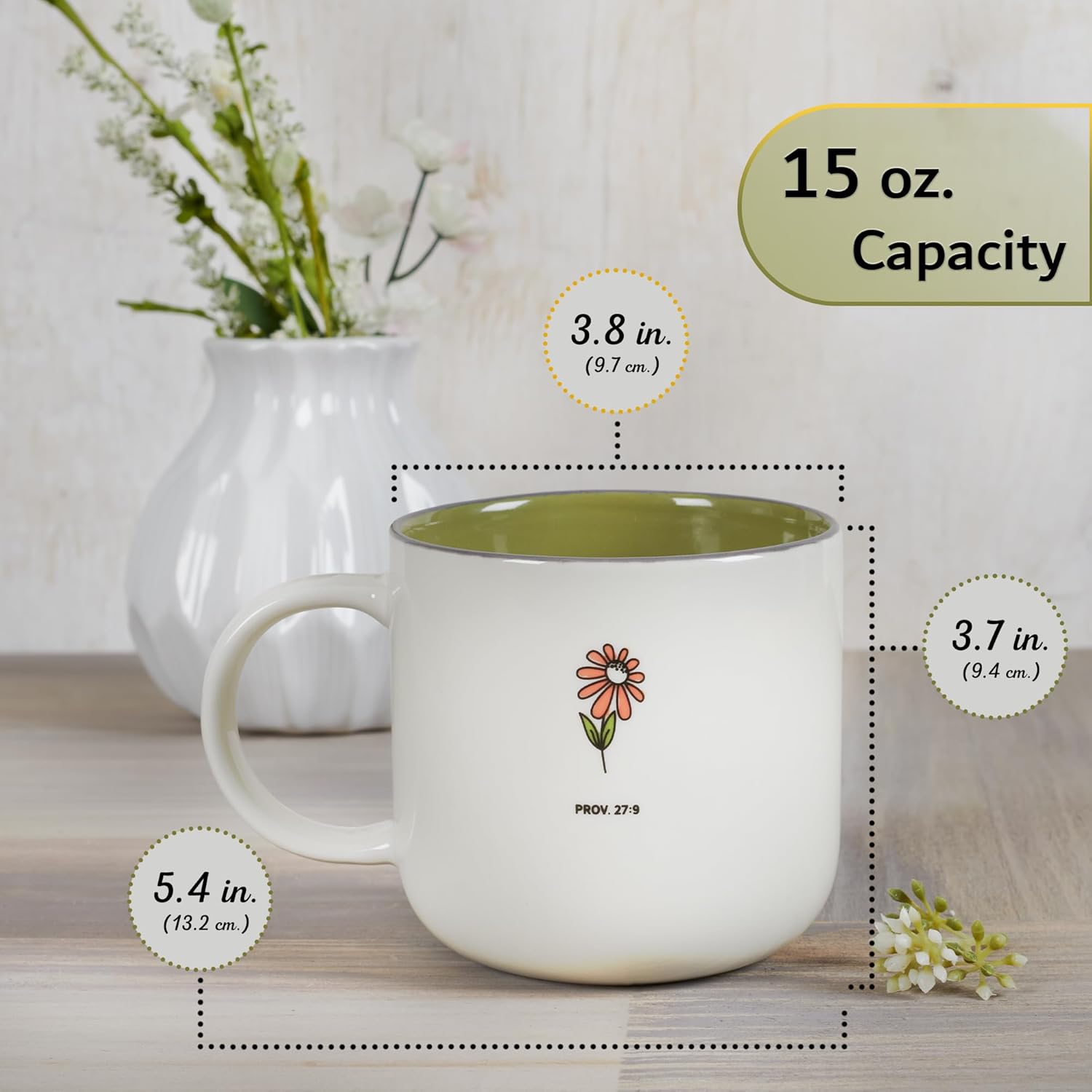
A scripture verse mug is probably the most common item in this gift category, and it has earned a mixed reputation — mostly because cheap mugs feel cheap. The things that separate a $14 mug worth giving from a $6 mug that chips in the dishwasher: ceramic weight (heavier mugs hold heat better and feel more substantial), whether the print is fired on (baked into the glaze, so it won’t fade or peel) rather than a vinyl decal applied after manufacture, and whether the verse is rendered with any real design care.
DaySpring’s ceramic mug line, which ranges from $12 to $18, uses fired-on printing and is widely noted by buyers as dishwasher-safe and durable over time. For a gift set, a 14–16 oz mug paired with a devotional keeps you comfortably in the $25–$35 range with two solid items.
4. The Personalization Question
Personalization — adding the teacher’s name, a date, or a short inscription — dramatically increases the perceived value of a gift without necessarily increasing its cost by much. The challenge in the under-$50 range is that true custom engraving (on metal or glass) typically pushes the price of even a single item past $30 on its own.
The practical workaround: a high-quality printed name card inside the gift, or a handwritten note on quality card stock, does more emotional work than a poorly engraved item. The Gospel Coalition’s 2024 piece on encouraging children’s ministry volunteers makes the straightforward point that written specificity — naming what the teacher did, what your child learned, what you noticed — matters more than the engraving itself. Don’t let the absence of engraving stop you from writing something real.
How to Build a Set Without Buying a Pre-Made Bundle
Pre-made gift sets have a convenience advantage, but they often include one strong item and two filler items to justify the price. Building your own from three categories — something to read, something to write in, something to use daily — gives you more control over quality at the same total price.
A reliable $40–$48 build:
- A focused devotional from DaySpring or a similar publisher: $14–$18
- A lay-flat journal with scripture cover art: $12–$16
- A quality ceramic mug with a fired-on verse: $12–$14
Add a handwritten card from your child. Keep the packaging simple — a kraft paper gift bag from any craft supply store costs under $3 and looks clean. The result is a gift that feels curated and personal without requiring a specialty retailer or a long lead time.
If you’re coordinating a group gift from multiple families (a common scenario at end-of-year Sunday school celebrations), pooling $10–$12 per family from four or five families puts you in the $40–$60 range where you can consider a single premium item — a bonded-leather ESV (English Standard Version) devotional Bible from Crossway, for instance, which retails around $35–$45 — rather than a multi-item set. Per Crossway’s gift Bible overview, their bonded-leather editions are designed specifically to hold up to regular use, with reinforced bindings and presentation pages for inscription. That’s a meaningful upgrade that a single $12 budget can’t reach but a group can.
Denomination and Appropriateness: A Quick Checklist
Relevant Magazine’s 2024 piece on church volunteer culture makes a useful observation: gift-givers often assume their own denomination’s norms apply universally, which leads to gifts that feel slightly off. Before you finalize anything, run through this:
- Do you know if the teacher is Catholic, Protestant, or nondenominational? Catholic recipients will generally appreciate devotionals that reference the liturgical calendar, the rosary, or Marian themes. Protestant recipients span a wide range — most DaySpring and similar products land safely in evangelical-friendly territory. When in doubt, a journal or mug with a verse from the Psalms is broadly appropriate across almost all Christian traditions.
- Is the verse translation marked on the product? Most mass-market scripture gifts use the NIV (New International Version) or ESV. Catholic recipients may prefer the NAB (New American Bible) or RSV-CE (Revised Standard Version, Catholic Edition). If the translation is printed on the product and it’s unfamiliar to the recipient, it can create a small but unnecessary awkward moment.
- Is the imagery cross-denominational? Avoid gifts that feature imagery specific to one tradition (certain saints, specific sacramental symbols) unless you know the teacher well enough to know it will resonate.
When genuinely uncertain, go with the journal and a mug. A blank journal says: I want you to have space to reflect. That’s hard to get wrong.
The Decision Rule
If you’re standing in front of a store display or a website with ten minutes to decide, here’s the framework:
- If you know the teacher well and know her tradition: buy the devotional that matches her context, add a journal, and write a specific note.
- If you’re one of several families pitching in: pool toward a single quality item — a gift Bible or a premium journal — rather than splitting the budget across multiple small items.
- If you’re uncertain about everything: a DaySpring ceramic mug plus a lay-flat journal keeps you in the $25–$30 range with two solid, appropriate items and leaves budget for a card that does the real emotional work.
The teacher who showed up every Sunday and poured into your kids deserves something that feels considered. In this price range, considered means fewer items chosen more carefully — not more items chosen quickly. Get the one thing she’ll actually use, write her a note that tells her what her faithfulness meant, and you’ve done it right.