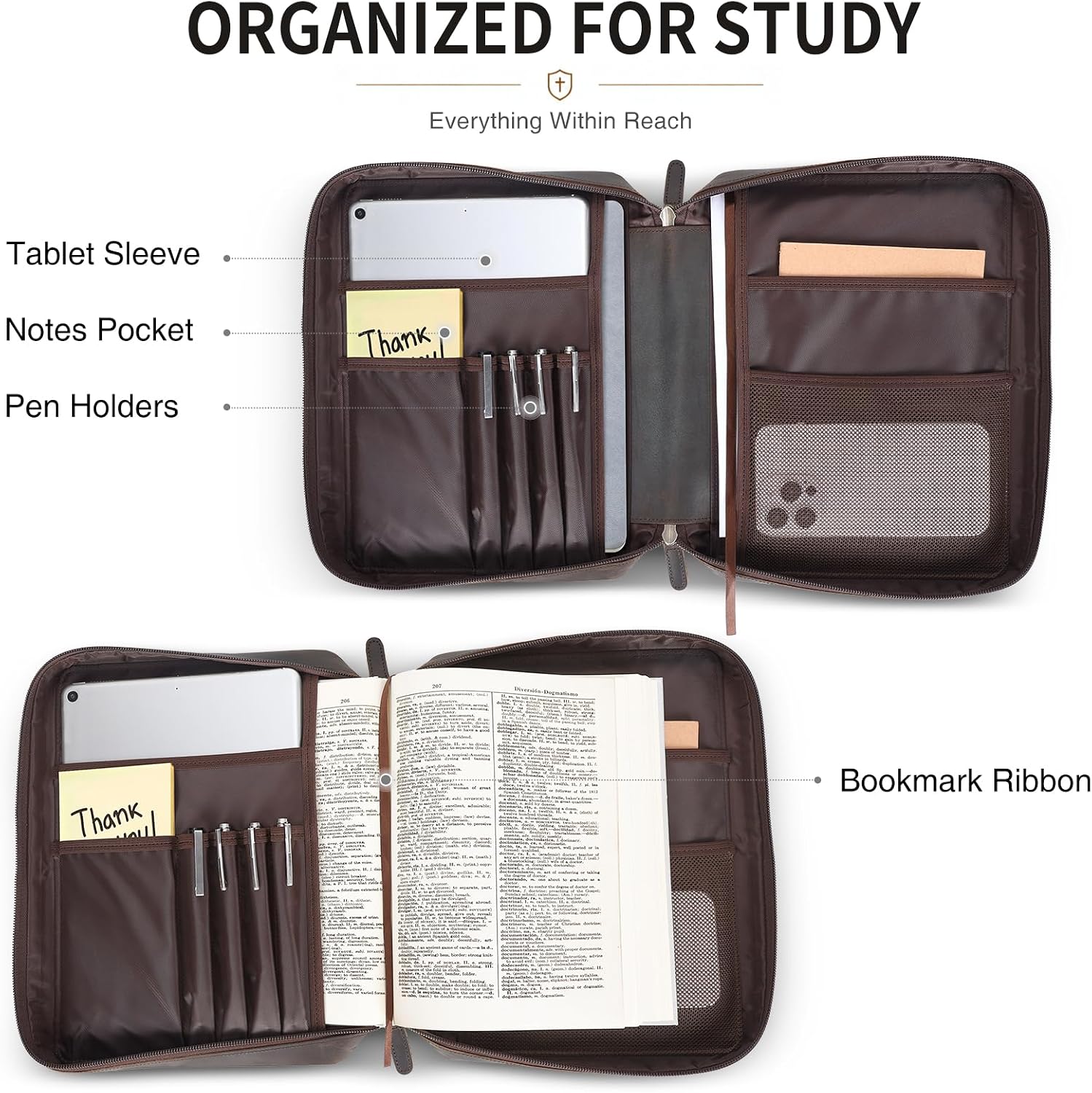
If you have ever stood in a Christian bookstore — or scrolled through a long product page — staring at two Bible covers where one costs $32 and the other costs $145, you have probably asked yourself: what on earth is the difference? The short answer is the material. A Bible cover (sometimes called a Bible case or slip cover) is a protective outer shell, usually zippered, that wraps around your Bible to shield it from daily wear. The material it is made from determines almost everything: how long it will last, how it will age, what it will feel like in ten years, and whether it makes a meaningful gift or just a placeholder. This guide walks you through the real tradeoffs between genuine leather and faux alternatives — including a confusing in-between category called bonded leather — so you can spend confidently at whatever price point fits the moment.
The Material Spectrum, From Bottom to Top
Before comparing, it helps to know that “leather” is not a single thing. The market offers four distinct materials, and they behave very differently over time.
Faux Leather (PU / Vegan Leather)
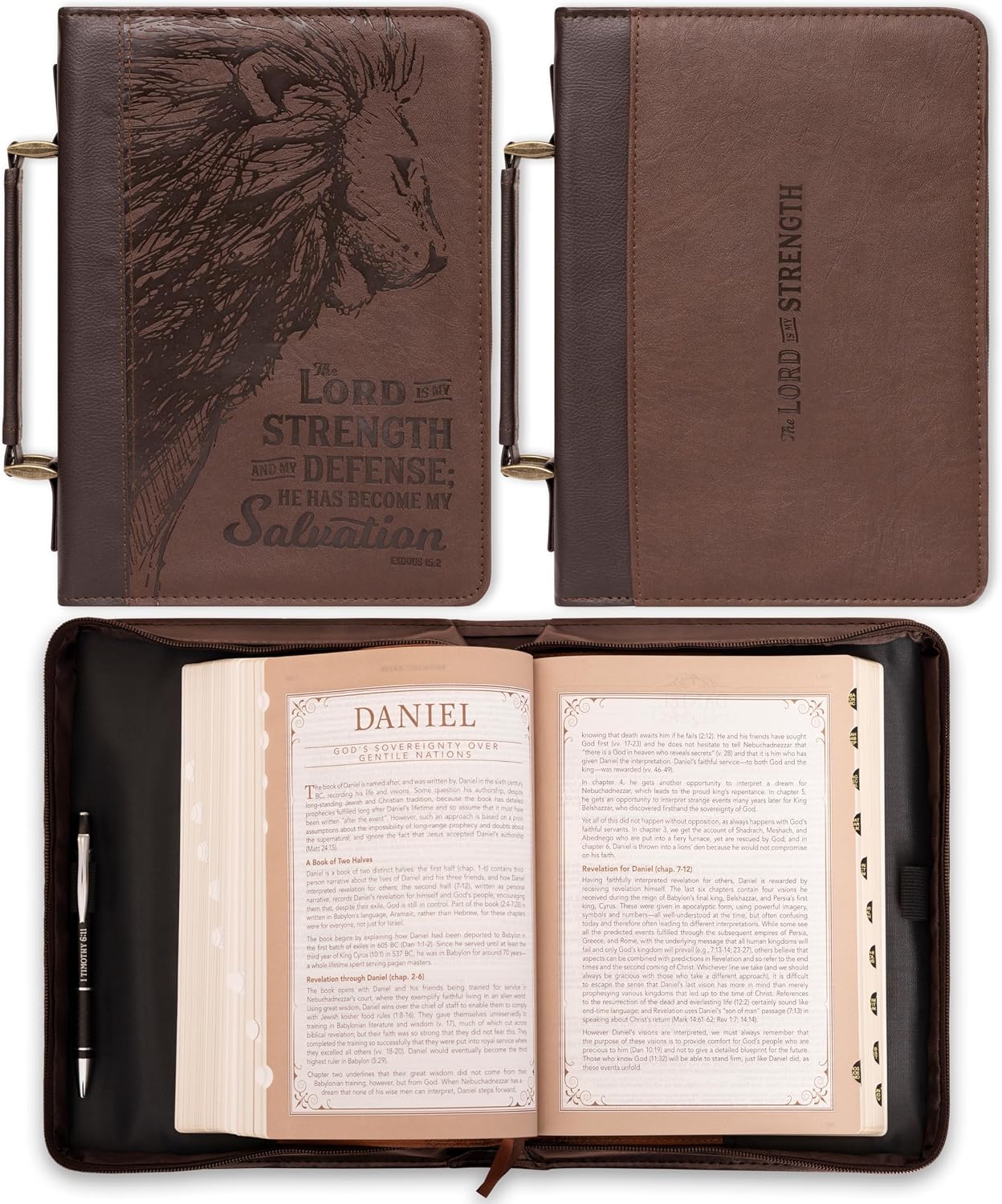
Faux leather — also marketed as PU leather or vegan leather — is a fabric or plastic base coated with polyurethane to mimic the look of real hide. Covers in this category typically run $18–$45, and the material can look convincing straight out of the packaging. The tradeoff is durability: polyurethane coatings are widely documented to crack, peel, and flake after two to four years of regular use, especially along fold lines and zipper edges. Good Housekeeping, in their guide to caring for leather goods, notes that PU surfaces cannot be re-conditioned the way real hide can, because there is no natural fiber structure beneath the coating to absorb conditioner. When a faux cover starts to fail, it fails visibly and irreversibly.
Christian
$24.99
In stock on Amazon
Check price on AmazonBonded Leather
Bonded leather occupies the most misleading position in the market. It is made by shredding genuine leather scraps into a pulp, binding that pulp with polyurethane or latex, and pressing it onto a fiber backing. The result looks and smells like real leather when new — which is why it appears so often on mid-range covers labeled simply “leather” at a $40–$80 price point. The problem is that the bond between the pulp layer and the backing tends to break down over time, causing the surface to bubble and flake in a way that is nearly impossible to repair. Crossway’s Bible Buying Guide: Covers and Bindings Explained (crossway.org) specifically identifies bonded leather as a material that may show significant wear within five to seven years of regular use, and advises buyers who want a cover to last a lifetime to move up to full-grain or top-grain options. Every dollar spent on bonded leather is better directed either down to honest faux leather or up to genuine top-grain — it is the one tier worth skipping entirely.
 product image](/images/external/4be1bfb5fd6a.jpg)
ELIZO
$49.97
In stock on Amazon
Check price on AmazonTop-Grain Leather
Top-grain leather is the first tier that genuinely earns the premium price. It comes from the upper layer of a full animal hide, lightly sanded to remove surface imperfections, then treated and dyed. It is thinner and more uniform than full-grain, which makes it workable for slim, elegant covers. Owners consistently report that top-grain covers develop a pleasant patina — a subtle darkening and softening that comes from natural oils in your hands — and that with occasional conditioning they remain supple for decades. Christianity Today’s feature “What Makes a Bible Worth Keeping” (christianitytoday.com) makes the case that a Bible used daily for devotional reading and marking is a relationship over decades, not a product; a cover that holds up to that relationship without peeling or cracking is a practical and emotional investment. Bible covers at this tier typically run $80–$160.
ELIZO
$49.97
In stock on Amazon
Check price on AmazonFull-Grain Leather
Full-grain leather is the most durable tier. It comes from the outermost layer of the hide and is processed minimally, preserving every natural marking — small scars, grain variations, slight color shifts. Those natural fibers are intact, making the hide denser and more resistant to moisture and abrasion than any other material. Full-grain covers are harder to find as standalone products (they are more common on premium Bible editions from publishers like Cambridge and R.L. Allan), but specialty craftspeople and some Christian artisan shops do offer them. The Gospel Coalition’s article “Choosing a Bible for the Long Haul” (thegospelcoalition.org) observes that the physical object communicates the occasion’s significance — a cover still intact in forty years says something a peeling one cannot. Expect to pay $140–$280 or more for full-grain.
 product image](/images/external/df9e508dfefe.jpg)
LEATHER
$69.99
In stock on Amazon
Check price on AmazonBy the Numbers
| Material | Typical Cover Price | Expected Lifespan | Can Be Reconditioned? |
|---|---|---|---|
| Faux / PU leather | $18–$45 | 2–4 years | No |
| Bonded leather | $40–$80 | 5–7 years | Minimally |
| Top-grain leather | $80–$160 | 15–25+ years | Yes |
| Full-grain leather | $140–$280+ | Lifetime (50+ years) | Yes |
Where the Price Gap Is Actually Worth It
The honest framing: not every Bible cover purchase requires a lifetime investment. The math shifts based on context.
For a child or early teen, a faux leather cover is a perfectly reasonable choice. Kids outgrow Bibles as they advance in reading level and study depth, often within three to five years. The Gospel Coalition’s “Choosing a Bible for the Long Haul” (thegospelcoalition.org) observes that most first Bibles for children are replaced not because they wear out but because the reader’s needs change. Spending $145 on a cover for a Bible that will be outgrown in four years is hard to justify — a $25–$35 faux option does the job.
For an adult daily reader, the calculus flips. A cover that starts peeling at year three creates a practical nuisance (flaking debris, damaged Bible pages) and an emotional one — it looks neglected when it is not. Top-grain leather at $100–$150 is the sweet spot: it holds up to daily handling, it can be conditioned with standard leather balm once or twice a year, and across aggregated owner reviews, buyers consistently describe these covers as looking better at ten years than at one.
For a milestone gift — confirmation, ordination, a pastor’s anniversary, a seminary graduation — full-grain leather or a high-quality top-grain cover becomes a statement about the weight of the occasion. The physical durability mirrors the intention: this is meant to last. Personalization matters at this level too. Many craftspeople and Christian gift shops offer hand-stamped or debossed monograms and scripture references on full-grain covers, typically adding $20–$60 to the base price. That engraving, done properly on full-grain hide, will still be crisp in thirty years.
For volume ministry purchases — baptism classes, confirmation cohorts, church plant launches — top-grain is usually the practical ceiling. It offers genuine longevity without the per-unit cost of full-grain, and many suppliers offer volume pricing that brings $120 covers down to the $85–$95 range per unit at quantities of twelve or more.
Construction Details That Outlast the Material Label
Material tier is the most important variable, but a few construction specifics determine whether a cover at any tier holds together over time.
Stitching thread and pattern. Look for covers with waxed or polyester thread rather than cotton. Cotton thread absorbs moisture and weakens over years of use; waxed or polyester thread resists it. A saddle-stitch pattern — two needles passing through each hole from opposite sides — is stronger than a lockstitch because if one thread breaks, the stitch holds rather than unraveling. Premium artisan covers typically call this out in their product descriptions.
Zipper quality. The zipper is the first component to fail on most covers, regardless of the leather quality. YKK zippers — a Japanese manufacturer whose products appear on virtually all high-end luggage and leather goods — are the recognized benchmark. Good Housekeeping’s leather care guidance echoes the broader consensus in home goods coverage: a beautiful full-grain cover with a cheap zipper is a liability. Owners across multiple review contexts consistently flag zipper failure as the reason otherwise-good covers get retired early.
Lining material. A microfiber or genuine suede lining protects Bible pages and prevents scuffing. Cheap polyester linings can pill over time and leave fibers on thin Bible paper — a small annoyance that compounds across years of daily use.
Pocket and pen loop placement. If the recipient carries their Bible to multiple weekly services, a small group, and personal study, consider whether the cover’s pocket and pen loop create an awkward bulk lump against the Bible’s spine. Spine pressure is the primary cause of cover warping over time, regardless of material tier.
Denomination and Style Fit
A quick note for gift-givers: Bible cover styles vary in ways that can read differently across faith traditions, and it is worth a moment’s thought.
Highly embellished covers — laser-cut floral cutouts, rhinestone accents, metallic inks — are common in charismatic and Pentecostal congregations and are warmly received there. They tend to feel out of place in more liturgically formal settings (traditional Anglican, Lutheran, or Presbyterian contexts) where a plain, dark-finished cover in black, dark brown, or navy reads as more appropriate. Catholic recipients who carry a NAB or NABRE translation are well-served by the same covers as Protestant readers; the Bible’s physical dimensions are the key fit variable, not the denomination.
For nondenominational or broadly evangelical contexts, a classic top-grain cover in black or cognac brown is the most universally appealing choice across buyer feedback.
The Decision Framework
Here is the clear if-then rule for every purchase scenario:
- Child or reader likely to replace their Bible within five years → faux leather at $18–$45. Do not overspend.
- Adult daily reader or dedicated student → top-grain leather at $80–$160 is the minimum worth considering. The longevity math genuinely favors it over two or three faux covers purchased across the same period.
- Milestone occasion — ordination, ministry anniversary, confirmation, seminary graduation → full-grain leather at $140–$280+, ideally with personalization. Crossway’s Bible Buying Guide (crossway.org) and The Gospel Coalition’s long-form piece (thegospelcoalition.org) both converge on the same point: the physical object communicates the occasion’s significance. A cover still intact in forty years says something a peeling one cannot.
- Volume ministry purchase → top-grain at a negotiated volume rate is the practical sweet spot. Reserve full-grain for leadership-level recipients within the same event.
The one mistake worth avoiding at every price point is bonded leather. It costs nearly as much as entry-level top-grain, it looks like real leather in the store, and it fails in a way that is both ugly and irreparable. Skipping bonded leather entirely — stepping either down to honest faux or up to genuine top-grain — is the single most reliable quality upgrade available regardless of budget.